- Jun 25, 2025
Why does my teen hate me?
- Next Level Portal

It's probably one of the hardest things a parent can hear.
"I hate you". Or even worse, them saying "you don't love me" when you're only trying your hardest.
Maybe you’ve felt the sting of these phrase (or its eye-roll equivalent). It hurts—deeply. Let’s talk about what’s actually happening inside your teen …and why you can have hope for restoration, even when things are this tense.
Why Teens Snap: The Adolescent Emotion Trap
The teenage brain is still wiring its amygdala (emotion center) and prefrontal cortex (logic-and-self-control center). When stress hits—social drama, deadlines, self-doubt—the emotion engine red-lines long before the rational brakes engage. Result: impulsive lash-outs, slammed doors, icy silence.
But neurobiology is only half the story.
When “I Hate You” Feels Personal—And Isn’t
Teens often project intense feelings they don’t yet understand. Five common roots:
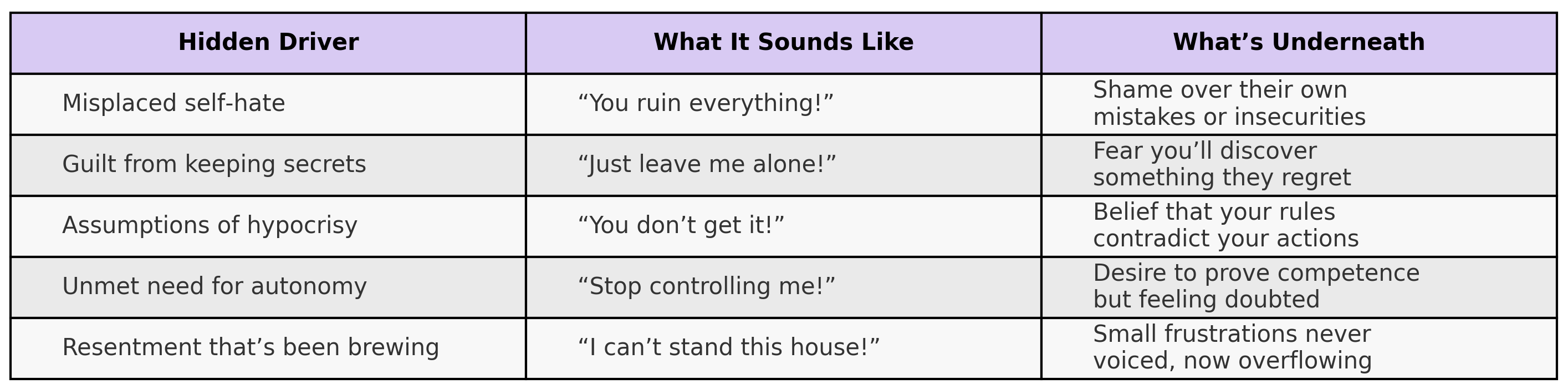
Strong feelings don’t have to be rational to feel 100% real to your teen. And that tension—between your love and their anger—is where relational injuries (and repairs) happen.
The Science of Self-Regulation & Repair
Adolescents who learn to label emotions show lower cortisol spikes (stress hormones) during conflict (Journal of Adolescent Research).
Reflective conversations (parent + teen) predict improved relationship quality six months later (Family Process).
Translation: naming feelings and debriefing conflict aren’t soft skills; they’re stress-relief valves and relationship glue.
How to Help—Without Nagging or Defending
1. Pause Together
At a calm moment—not mid-fight—say:
“Yesterday got intense. I care more about us than the argument. Can we unpack it when you’re ready?”
2. Name the Feeling (Not the Fault)
“It sounded like you felt cornered. Does that fit?”
Labelling externalizes the emotion so it’s you and teen versus the feeling, not you versus them.
3. Invite Perspective
“What do you think I might not understand yet?”
Even if they say, “Everything,” you’ve opened a door.
4. Share Your Inner World
“I got loud because I was scared, not angry. I didn’t say that well.”
Modeling vulnerability shows how adults own mistakes without self-loathing.
5. Create a Micro-Repair Ritual
After any blow-up, agree to one small reconnecting act (a walk, shared meme, five-minute game). Ritual = predictability = safety.
Why This Matters
Teens who experience repair after rupture learn that relationships survive honest conflict.
They carry lower resentment into adulthood—and into their future families.
Household stress drops because you’re tackling the fire, not yanking out the smoke alarm.
Your teen’s words may cut, but they’re almost always pointing to an internal battle. When you treat the outburst as data instead of disrespect, you change the story from parent vs. teen to team vs. problem.
Next week, we’ll dig into how your own self-regulation sets the emotional temperature for the entire house—and practical ways to keep that thermostat steady.
Until then, breathe easy. Your presence, even in tense moments, is teaching your teen how to handle the world.
Warmly,
Tristan
Seen something helpful here on our blog?
Get free professional insights by signing up for our email mailing list
Plus we'll keep you up to date on new solutions, giveaways and more!
EXCLUSIVE LIVE COACHING AND MENTORSHIP
Students and parents who are enrolled in the Future Forge program are eligible for our live coaching or mentorship programs.
These programs involve regular private check-ins to support, encourage and discuss course content, life circumstances or whatever is on thier mind.
This program is for students or parents who desire a more personalized counselling coaching experience