- May 27, 2025
Why your teen tunes you out—and how to flip the switch
- Next Level Portal .

Let’s talk about one of the most frustrating experiences in parenting a teenager:
They’re standing right in front of you.
You’re speaking.
And somehow—it’s like they’re not even there.
The eye roll. The blank stare. The dramatic sigh.
Or worse: the fake nod, and then five minutes later… nothing changed.

If this feels familiar, I want to unpack something that’s happening under the surface. Because the problem usually isn’t what you’re saying—it’s how their brain is receiving it.
And once you understand that? Everything changes.
Your Teen's Brain Isn’t Broken—It’s Just in Renovation
During adolescence, the brain goes through a massive restructuring process. One of the most important areas affected is the prefrontal cortex—the part responsible for decision-making, impulse control, and long-term planning.
But here’s the catch: the emotional center of the brain (the amygdala) is developing faster than the logical center.

So when your teen is flooded with emotion—anger, embarrassment, anxiety—they are literally less able to hear and process logical input. The message you’re trying to get across gets hijacked before it even lands.
And because their brain prioritizes emotional threat over connection (even if you don’t think you’re being threatening), they often shut down, argue, or disengage.
The Psychology of "I Don't Want to Hear It"
Now add in another layer: the psychology of reactance.
Reactance is the instinctive resistance we feel when we perceive our freedom is being threatened. It’s why a teen will argue against something even when they secretly agree with you.
Studies from the University of Rochester show that teens are more likely to engage with guidance when it’s framed in autonomy-supportive ways—not authoritarian ones.
That means:
Leading with curiosity instead of correction
Asking questions before offering solutions
Giving space for them to reflect, instead of pushing for immediate agreement
The research backs it up: when teens feel heard first, their resistance drops significantly.
But What About the “Serious” Stuff?
Now you might be thinking, “That sounds great for everyday conversations—but what about when I need to lay down the law?”
Here’s the key insight: Connection doesn’t replace boundaries. It makes them possible.
When your teen trusts that you’re not just trying to win the argument, but actually trying to understand them, they listen more—even when they don’t like what you’re saying.
In fact, a 2020 longitudinal study found that teens with secure attachment to a parent were twice as likely to comply with house rules over time—not because the rules were harsher, but because the relationship gave those rules meaning.
So What Can You Do Today?
Here are 3 micro-adjustments that make a big difference:
Replace “Why did you do that?” with “What was going on for you when that happened?”
This removes blame and invites honesty.Use the phrase “Can I share something with you—and you can tell me what you think?”
This triggers autonomy and lowers resistance.Pause the lecture. Ask them to summarize what they heard you say.
This reveals gaps in understanding without turning the conversation into a power struggle.
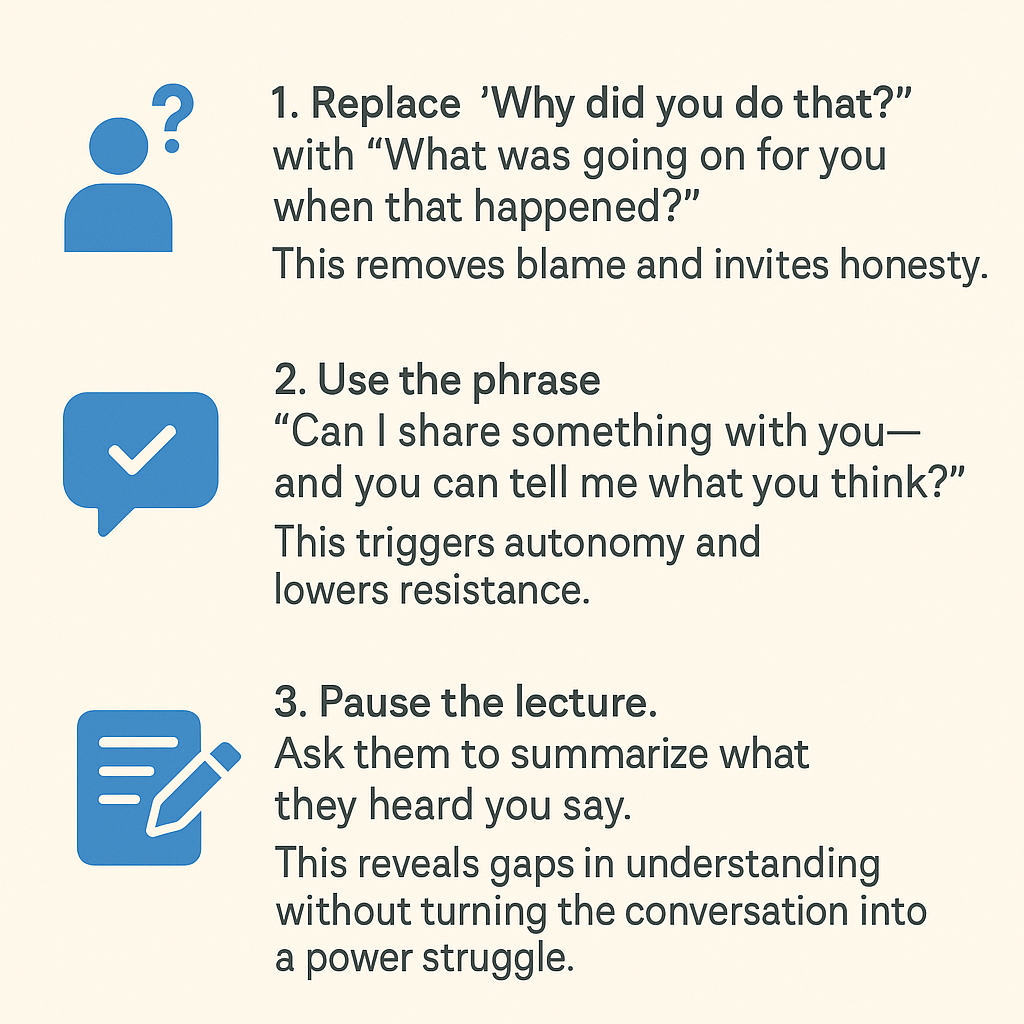
These aren’t gimmicks. They’re brain-aware communication tools. And they work.
I teach dozens of strategies like these inside Raising Resilient Teens—but even if you never join, I hope today’s insights give you something practical to work with right now.
Because the real goal?
Isn’t to win the conversation.
It’s to win back the relationship.
You’ve got this. And if you want help along the way—I’m here.
With care,
Tristan

Seen something helpful here on our blog?
Get free professional insights by signing up for our email mailing list
Plus we'll keep you up to date on new solutions, giveaways and more!
EXCLUSIVE LIVE COACHING AND MENTORSHIP
Students and parents who are enrolled in the Future Forge program are eligible for our live coaching or mentorship programs.
These programs involve regular private check-ins to support, encourage and discuss course content, life circumstances or whatever is on thier mind.
This program is for students or parents who desire a more personalized counselling coaching experience